
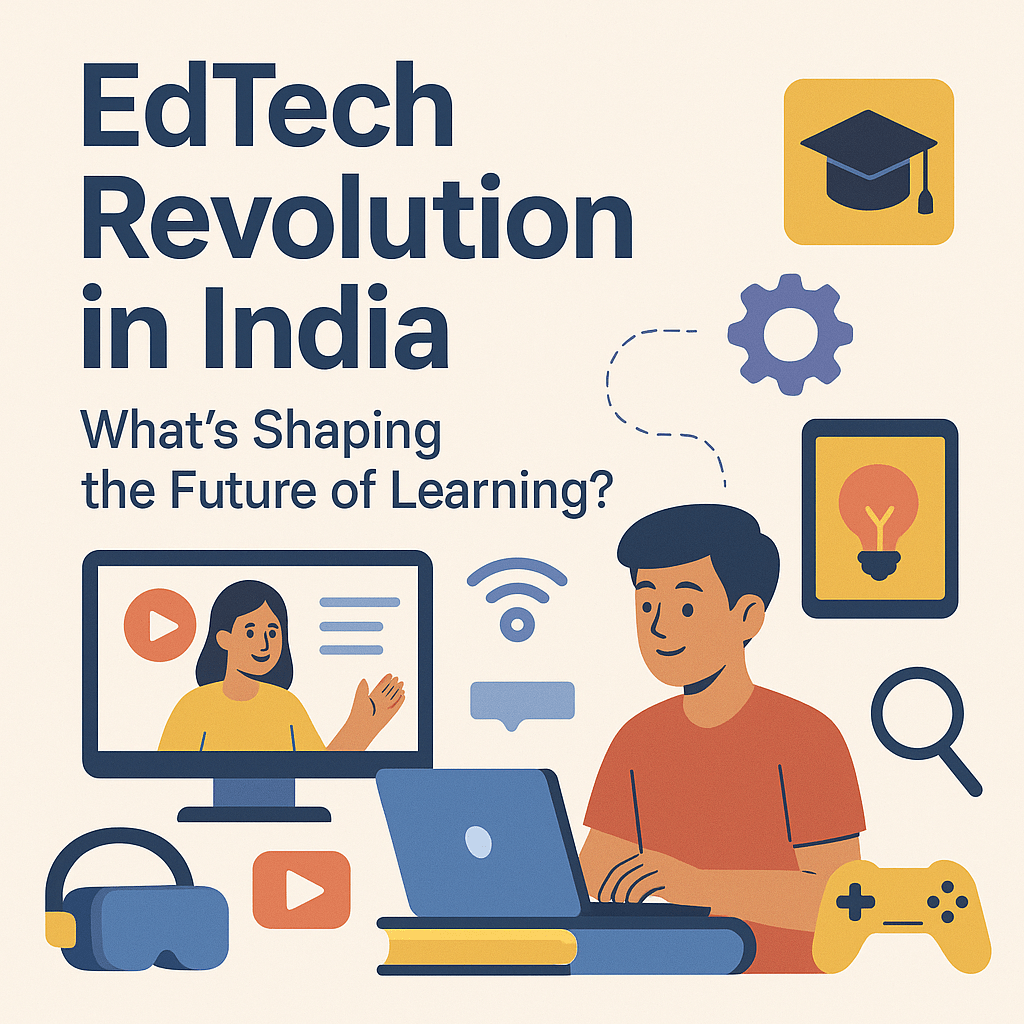
EdTech Revolution in India – What’s Shaping the Future of Learning in 2026?
Think about how a student in a small town in Bihar or Rajasthan used to prepare for competitive exams just ten years ago. A local coaching centre, a few textbooks, and hope.
Now picture the same student in 2026 — learning from an AI-powered tutor that adapts to her pace, watching 3D simulations of human anatomy on a tablet, and earning a certified online course from a top institution without leaving her district.
That shift is the EdTech revolution in India. And it is not slowing down.
India is home to one of the world’s largest student populations — over 250 million students at the school level alone, and tens of millions more in colleges and universities. Reaching all of them with quality education has always been the central challenge. EdTech is finally making that possible — at scale, affordably, and across languages.
In this article, we break down exactly what is driving India’s EdTech revolution in 2026, what technologies are leading the change, and what it means for students, parents, and institutions across the country.
What Is EdTech and Why Does It Matter for India?
EdTech — short for Educational Technology — refers to the use of digital tools, software, and platforms to improve how people learn and teach. It includes everything from online learning platforms and AI tutors to virtual reality classrooms and data-driven assessment tools.
For India, EdTech is more than a trend. It is a necessity.
The country faces a massive mismatch — between the quality of education available in urban and rural areas, between the number of qualified teachers and the number of students who need them, and between what colleges teach and what employers actually need.
EdTech is bridging these gaps — one student at a time.
India’s EdTech sector was valued at around $750 million in 2020. By 2030, it is projected to grow into a $30 billion industry. The growth is powered by affordable smartphones, expanding 4G and 5G internet access, the New Education Policy (NEP 2020), and a generation of students who are native to digital interfaces.
Key Forces Driving the EdTech Revolution in India
1. Artificial Intelligence — The Personalized Tutor for Every Student
One of the biggest problems with traditional classroom education is that it treats every student the same. The teacher follows a fixed curriculum at a fixed pace, and students who fall behind rarely get the individual attention they need.
AI is changing that completely.
AI-powered adaptive learning platforms study each student’s performance — which topics they find easy, where they get stuck, how long they take to answer — and then automatically adjust the content, difficulty, and pace accordingly.
If a student in Lucknow struggles with quadratic equations, the AI does not move on. It offers more practice problems, different explanations, and even video demonstrations until the concept clicks.
This kind of personalized learning was once only available to students with private tutors. In 2026, AI makes it available to anyone with a smartphone.
Platforms like BYJU’S, Vedantu, and Unacademy use AI algorithms to create these personalized learning journeys. Government-backed platforms like DIKSHA are also incorporating AI to support students in government schools across India.
2. Augmented Reality & Virtual Reality — Making Learning Come Alive
Reading about the solar system is one thing. Flying through it is another.
Augmented Reality (AR) and Virtual Reality (VR) are bringing subjects to life in ways that textbooks simply cannot. Students can explore ancient historical sites, conduct chemistry experiments in virtual labs, or walk through the human circulatory system — all from a classroom or at home.
For schools in tier-2 and tier-3 cities where labs and equipment are limited, VR labs offer a cost-effective alternative that also happens to be more engaging.
Research consistently shows that immersive, experiential learning leads to better retention and deeper understanding. That is why more Indian schools and EdTech platforms are investing in AR/VR content modules in 2026.
3. Gamification & Microlearning — Keeping Students Engaged
Attention spans are shorter than ever. Students, especially from Gen Z and Gen Alpha, are accustomed to fast, interactive content. Traditional lectures — even online ones — struggle to hold attention for long.
Gamification solves this by turning learning into a rewarding experience. Students earn points, unlock levels, compete in challenges, and receive instant feedback — exactly like a game, but with real educational content underneath.
Microlearning takes a similar approach. Instead of 90-minute lecture videos, content is broken down into short 5-10 minute modules focused on a single concept. Students can learn in spare moments — on a commute, during a lunch break, or before bed.
Together, gamification and microlearning have dramatically improved completion rates and learning outcomes on digital platforms.
4. Hybrid Learning — The Best of Both Worlds
COVID-19 forced schools and colleges across India to shift online virtually overnight. When institutions reopened, something unexpected happened: neither students nor institutions wanted to go back to purely offline learning.
Hybrid or blended learning — combining online and offline methods — became the new normal. And in 2026, it is the dominant model.
In a hybrid setup, recorded lectures and reading materials are available online. Classroom time is used for discussions, doubt-solving, group work, and hands-on activities. This approach makes better use of both teacher time and student attention.
For students in rural areas or those with irregular school attendance, hybrid learning ensures they do not fall behind. For urban students, it offers the flexibility to revisit content and learn at their own pace.
5. Career-Linked Education — Bridging Skill Gaps
India graduates millions of students every year. Yet employers consistently report difficulty finding candidates with the right skills. This is the education-employment gap — and EdTech is directly addressing it.
In 2026, leading EdTech platforms have evolved into career accelerators. They partner with companies to design course content based on real job requirements. Certifications are recognized by employers. Students get access to internship programs, mentorship from industry professionals, and placement support — all through the platform.
Platforms like Coursera, upGrad, and Simplilearn are leading this shift in India. Even traditional universities are now tying up with EdTech companies to offer career-linked elective programs.
For students exploring the right college or course, PathGyan’s listings of the best colleges in India can help you find institutions that are already embracing this model.
6. Data-Driven Teaching — Smarter Decisions for Educators
Teachers in traditional classrooms often have limited visibility into how each student is performing. A written test at the end of a chapter is usually the only data point available.
EdTech platforms give educators something far more powerful — real-time dashboards.
Teachers can now see which students watched a lecture video, how many times they paused it, which questions they got wrong, and how their performance has trended over weeks. This data helps teachers identify struggling students early and intervene before the situation worsens.
This shift from gut-feel teaching to data-driven instruction is one of the most impactful — and underappreciated — changes that EdTech is bringing to Indian classrooms.
Government Initiatives Powering India’s EdTech Growth
India’s EdTech revolution is not happening in a vacuum. The government has been a significant driver through several key initiatives:
PM eVIDYA — A unified digital education platform that brings together DTH TV channels, radio, and online portals to deliver learning to students across India, including those without internet access.
DIKSHA (Digital Infrastructure for Knowledge Sharing) — A national platform offering digitized textbooks, teacher training modules, and learning content in multiple regional languages. As of 2026, it hosts millions of pieces of content across 30+ languages.
NPTEL & SWAYAM — Free open-access online courses from IITs and IIMs, now available with proctored certification exams. Millions of college students across India have used these to supplement their formal education.
Atal Tinkering Labs — Over 10,000 labs established in schools across India to encourage students to explore robotics, IoT, 3D printing, and design thinking from an early age.
National Education Policy (NEP) 2020 — The NEP has been a game-changer, encouraging multidisciplinary learning, vocational training integration, and the adoption of technology throughout the education system.
These programs are making EdTech accessible not just in metro cities but in the remotest corners of the country.
EdTech Impact Across India — A Snapshot
| Segment | Impact of EdTech in 2026 |
|---|---|
| School Students | AI tutors, gamified apps, hybrid classrooms |
| College Students | MOOC certifications, virtual labs, career platforms |
| Rural Learners | Regional language content, DTH-based learning |
| Working Professionals | Upskilling, micro-credentials, industry-linked courses |
| Teachers | Real-time dashboards, digital content libraries |
| Institutions | Data analytics, LMS platforms, blended delivery |
EdTech and the Indian School System
The impact of EdTech is most visible — and most needed — at the school level.
India has over 1.5 million schools, many of which lack proper infrastructure, qualified teachers, and updated learning materials. EdTech is plugging these gaps through digital content libraries, teacher training apps, and government-provided tablets and smart TVs in classrooms.
Programs like Sampark Smart Shala have introduced tech-powered learning in rural schools, complete with teacher training, to improve foundational literacy and numeracy in early grades.
At the same time, urban private schools are adopting fully integrated EdTech platforms — from smart boards and interactive lessons to AI-generated assessments and parent-facing progress dashboards.
Whether you are looking for schools that have embraced this digital future, explore PathGyan’s state-wise listings like best schools in Delhi, best schools in Maharashtra, or best schools in Haryana to find institutions leading on this front.
EdTech and Higher Education — What’s Changing for Colleges & Universities
Colleges and universities in India are under pressure from two sides. Students expect more flexible, relevant, and career-focused education. Employers demand graduates with practical skills and industry exposure.
EdTech is helping institutions on both fronts.
Universities are now offering online and hybrid degree programs that attract students from across the country — and even internationally. Virtual labs, AI-graded assignments, and industry-partnership courses are becoming standard features at top institutions.
If you are a student evaluating options, PathGyan lists the best universities in India with details on courses, affiliation, and facilities — helping you find institutions that align with where education is heading in 2026.
You can also explore state-specific university options like best universities in Karnataka, best universities in Rajasthan, or best universities in Uttar Pradesh.
Challenges the EdTech Sector Still Faces in India
It would be unfair not to acknowledge the real challenges that exist alongside all this progress.
Digital divide — Despite rapid internet expansion, millions of students in rural and tribal areas still have limited or no access to reliable internet and devices. Bridging this gap remains critical.
Content quality — Not all EdTech content is good content. As the sector grows, ensuring consistent quality across platforms is an ongoing challenge.
Teacher readiness — Technology is only as effective as the educators using it. Many teachers, especially in government schools, still need training and support to integrate digital tools effectively into their teaching.
Screen fatigue — Students spending excessive hours on screens face burnout and health concerns. Platforms need to build better balance into their design.
Regulation and quality control — As EdTech companies grow rapidly, there is a growing need for proper accreditation frameworks and quality standards — especially for certifications that claim industry value.
These challenges are solvable — and the best players in India’s EdTech space are actively working on them.
Frequently Asked Questions (FAQs)
Q1. What is the EdTech revolution in India? The EdTech revolution in India refers to the rapid adoption of digital technology in education — including AI-powered learning, online platforms, VR classrooms, and data-driven teaching tools — that is fundamentally changing how students across India learn.
Q2. How big is India’s EdTech market in 2026? India’s EdTech sector is one of the fastest-growing in the world. Valued at around $750 million in 2020, it is on a growth trajectory projected to reach $30 billion by 2030, driven by affordable internet, smartphone penetration, and government digital education programs.
Q3. Which government programs are supporting EdTech in India? Key government initiatives include PM eVIDYA, DIKSHA, SWAYAM, NPTEL, Atal Tinkering Labs, and the National Education Policy (NEP) 2020. These programs are expanding access to digital education from metro cities to remote rural areas.
Q4. Is EdTech only useful for students in cities? No. In fact, EdTech has arguably made the biggest difference in rural and semi-urban areas — where quality teachers and infrastructure are scarce. DTH-based learning, regional language content, and offline-capable apps are making quality education accessible across India.
Q5. How is AI being used in Indian education? AI is used to create personalized learning paths, identify struggling students early, automate assessments, generate practice questions, and power smart tutoring systems that adapt to each student’s individual strengths and weaknesses.
Q6. How does EdTech help students choose the right college or university? Platforms like PathGyan complement EdTech by helping students research and compare institutions across India. You can explore best colleges in India and best universities in India to make informed decisions about where to study.
Q7. What is the role of NEP 2020 in India’s EdTech growth? NEP 2020 is a landmark education reform that actively encourages digital learning, multidisciplinary education, vocational integration, and regional language instruction. It has created a supportive policy environment for EdTech adoption at all levels of India’s education system.
Final Verdict
India’s EdTech revolution is real, it is fast, and it is already changing millions of lives.
From an AI tutor helping a student in rural Jharkhand crack a competitive exam, to a VR lab giving a school in Chandigarh students a first-person experience of ancient civilizations — technology is making quality education more personal, more accessible, and more effective than ever before.
But technology alone is not enough. The best outcomes happen when good EdTech tools are combined with good schools, good colleges, and good teachers. That is why finding the right institution still matters.
Use PathGyan to explore best schools in India, best colleges in India, and best universities in India — and make your education decision in 2026 with full confidence.
The future of learning in India is digital, inclusive, and full of possibility. The EdTech revolution is just getting started.
Recent Posts



All Categories
Related Article...

PathGyan – India’s No. 1 Online Listing Website for Schools, Colleges & Universities (2026)

Why Pathgyan’s Free and Unlimited Online Video Maker Is Perfect for Everyone

Generate QR Codes Instantly – Free & Unlimited with Pathgyan

Free Unlimited Meme Maker – Create Funny Memes Instantly Online!

How to Choose the Right School in India for Your Child’s Future